
Japan Foreign Experts Program: Pre-Program Thoughts
My impressions of Japan before I arrived

I am fortunate enough to have been invited by the Japanese Ministry of Foreign Affairs to visit Japan for a week. This is the first post of a daily account of my impressions. In addition to building bridges with my peers in Japan, my main goal is to see what lessons Arabs can learn from Japan.
According to the its rubric, the program’s objective is “provide foreign experts (e.g. intellectuals, media, policymakers) with accurate information about Japan, including its culture, domestic and foreign policies.” It also aims to facilitate building lasting connections between the visitor and Japanese experts across many fields. The Japanese Ministry of Foreign Affairs is generously hosting me for this program, organizing a large number of visits to research and cultural institutions, and providing a chaperone to help me navigate Japan. I will be staying for approximately one week.
Prior to arriving, my main source of non-popular information about Japan came from Jared Diamond’s book Upheaval, which talks about how seven different societies encountered crises and learned from them. Japan was one of the countries considered, with the crisis being the 1853 forced opening of Japan by American Commodore Matthew Perry, and the ensuing Meiji Restoration. I read that book in the context of the book that I am currently writing with my fiend and colleague, Dr. Odeh Jayyousi, about why Arab countries perform poorly when it comes to learning from crises. We hope to complete that book in the coming weeks.
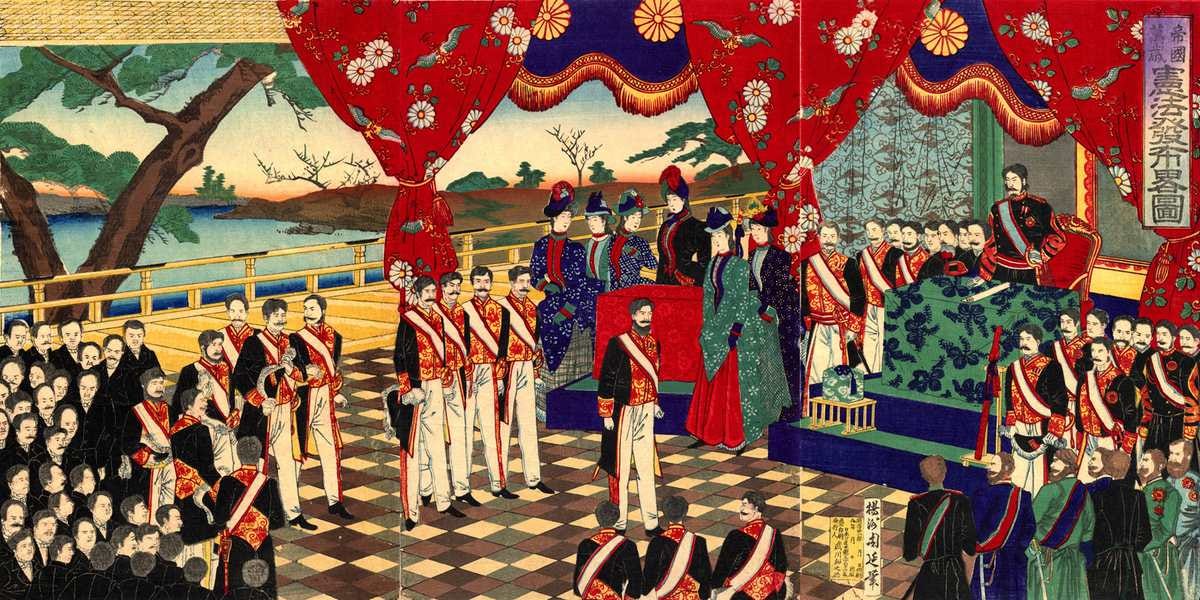
As a scholar who wants to use his research to help Arabs better themselves, the transformation that Japan underwent following the shock of Perry’s arrival is a great source of inspiration. Three aspects of the Meiji Restoration stand out to me in particular.
The first is that Japan went through some painful self-reflection in which they acknowledged the ways in which their society was poorly adapted to the new world emerging during the 19th century. While their warriors were fearsome swordspeople, their armed forces were no match for the militaries of countries such as Germany and the US, and their economy was totally uncompetitive after centuries of closure. Like all societies, the Japanese have a strong sense of dignity, and so coming to terms with your own deficiencies is a bitter pill to swallow. Nevertheless, doing so was the right decision, as being prideful would have put them on a path toward subjugation under the heels of foreign powers.
The second positive aspect was the highly systematic manner in which the Japanese went about learning how to improve themselves. In the 21st century Arab world, when our delegations travel to foreign countries ostensibly to learn, the visits are invariably more about showing off what we are proud of (sometimes even if it isn’t particularly notable), in addition to some light tourism. Seldom do we see our representatives going with a truly open mind and an earnest desire to absorb lessons that we can take home and implement.
In contrast, the 19th century Japanese delegations were under strict orders to learn from the best to become the best. The students had a humble attitude and took notes assiduously, and their efforts were matched by the willingness of their compatriots back home to actually benefit from the knowledge being amassed. The dramatic demonstration of the success of this approach was Japan’s victory in the 1904-05 Russo-Japanese War, an outcome that would have been unthinkable when Perry’s ships arrived in the island state half a century earlier.
Finally, I also have great admiration for the manner in which the Japanese married their desire to learn from the best with a commitment to maintaining their cultural identity. They did not treat Japanese culture as a tabula rasa ready to be molded into a horrific mutant of contemporary Great Power cultures. Instead, they made carefully considered decisions about what to import and what to maintain, as they balanced the desire to improve in an abstract sense with a desire to keep a link to their past, and to ensure that being Japanese meant something to its citizenry.
With this in mind, today in 2024, as an Arab studying how Arabs learn from crises, I am looking to get answers to several important questions. The first is: how did the Japanese manage to organize their learning during the Meiji Restoration, and ensure that their elites avoided the easy path of dragging their feet and hiding behind an attitude of “this is how we do things!”? Moreover, have they managed to sustain this until now? If so, how? And if not, what has caused this regression in openness to learning from foreign cultures?
My second question regards the role of the military. How did the Japanese build an effective military force during the 19th century – culminating in their impressive victory over the Russians – without transforming into a military dictatorship? Or – and I am very ignorant of Japanese history – perhaps they did take that route. My interest in this question stems from my observation that in many Arab monarchies, there may be a reticence by the civilian hereditary leaders to establish a highly effective military force due to fears of a coup. This makes them lean toward depending on external security guarantees that are now appearing less reliable than once before. Accordingly, the question of how to create a powerful army that respects civilian leadership and restricts itself to its defensive military mandate is central to the future prosperity of Arab monarchies.
I look forward to sharing my observations over the coming days!
Several books and lessons in one short article. Thank you, Omar Al-Ubaydli